COPE
why I'm writing about graffiti writers

Back when I was 19 or 20 and studying how to make art,
I had an idea :
a t-shirt that would have my handwriting on it as a graphic, enlarged via scanner and printed by silkscreen.
The message:
WE LEARN MORE
FROM T-SHIRTS
THAN TEACHERS
I enjoyed the slippery dichotomous language of Kanye West’s raps,
“…whether you broke or rich, you gotta get biz—
Having money’s not everything—
Not having it is”
and the chiasmatic raps of Juelz Santana reminded me of Gertrude Stein
I got a ho selection (yeah),
a whole collection (yeah)
A whole selection (yeah),
And as a studious youngster, with a full tuition scholarship it felt salacious and rebellious.
I loved t-shirts and graphics, I had even previously tried to get graphics accepted by www.threadless.com, and I still believed in the power of metaphor and snark. This was when print on demand was still in its infancy, (cafepress and zazzle, what up!) but we had iron-ons, and stencils, and spray paint, and permanent markers, and puff paint, and silkscreens. I believed that the historical avant-garde movements had something in common with me and the things in my life. I read Adbusters magazine, stole from Tower Records and Barnes and Noble, sent money to random guys in Minnesota to get vinyl stickers made, and made zines and mini-comix with photocopiers, sometimes collaborating with friends.
As a millennial, I had almost completely unfettered access to more information and media than any generation before me, more quickly, but this made me feel like I had ‘just missed the boat’ of the groundbreaking activities of those who were young in the 60s, 70s, and 80s. All of this is to say I knew a thing reaching more people didn’t intrinsically make it a better thing, and my passion for underground music and non-mainstream pastimes were just a few of the ways I proved that to myself, at least as much as being Black in America did, where if I believed more was better in all situations, my ‘minority’ status within this country would have left me downtrodden.
So if your message ain’t shit, fuck the records you sold!
'Cause if you go platinum, it's got nothing to do with luck
It just means that a million people are stupid as fuck
—Immortal Technique, Industrial Revolution
While a young teenager in the early 2000s, I was grappling with how the visions of the future I grew up with had not come to be. There were no flying cars or teleporters or hoverboards, but plenty of new modalities of discrimination and violence. I was fascinated by modernism, though I was given daily reminders of the ways in which it had failed, such as crumbling public housing infrastructure. Nonetheless I was drawn to it because there was an idea of creating new aesthetics to go with a new and better society. “Less is more” was an adage popularized by modernist architect Mies Van Der Rohe, and that saying was proven powerful partially because many people heard it and repeated it or tried to make it doctrine. Still, passive consumerism was the law of the land, and advertising instilled reverence for those laws. This process was achieved through repetition and saturation, amongst other methods. It was 2005-2006 when I saw an MTA whole train car covered in a vinyl wrap with Target bullseyes and I thought “why is this okay, but spray painting a mural on one isn’t?” Just because someone paid for it?
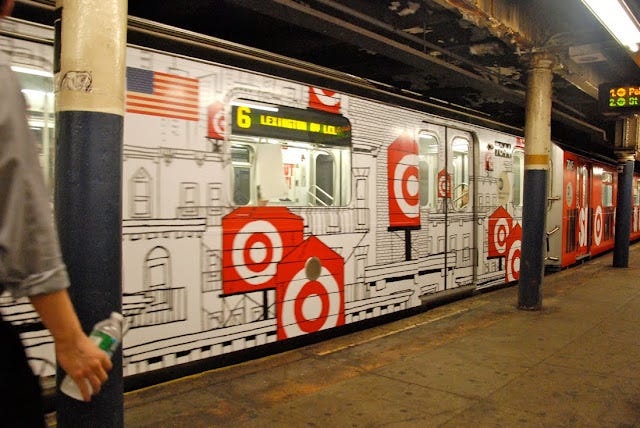
(correction : it was 2010 apparently. I’m sure I had seen a Target car before graduating though…maybe it was just a single car and not the full train )
I am reminded of the film Style Wars by Tony Silver and Henry Chalfant which is a documentary on the golden age of NYC graffiti of the late 1970s to early 1980s. One figure, positioned as a cantankerous antagonist to the mostly Black and Puerto Rican group of graffiti writers profiled is a non-descript, schlubby strawberry blonde mustachioed white man who goes by the name of CAP. He famously said “I’m not a graffiti artist, I’m a graffiti bomber. It’s just two styles of graffiti that are trying to coexist with each other, but it ain’t gonna work like that.” And “especially with me, the object is more. Not the biggest and the beautifullest, but more… it’s like, a little piece on every [train] car is what counts— not one whole car on every 30 cars that goes by.” Bombing was an essential element of graffiti at that point already, as through frequency, you not only refine and develop your signature, your ‘tag’ or ‘hit’, but also become visible to other writers, which gets you ‘fame’, respect from others who dare write their names on property that doesn’t belong to them in public. But CAP took bombing to a different place : using his throw-up (a form of graffiti which was relatively new at the time, developed from the softies by PHASE2) instead of tags. He would not aspire to make great masterpieces on the train, just be visible and everywhere.
CAP later tries to go deeper, making his actions not just a matter of ego, but a matter of loyalty by stating “Anybody who tries to screw around with me and my friends, I go over everything they got—forever.” It’s not clear what the “screwing around” was… but I assume it is the act of going over someone’s graffiti, but maybe it was merely embarrassing or “burning” them by having stronger work on the train line.
The understood and agreed upon rules of graffiti were that burners and big productions rightfully go on top of pieces, pieces go over throw-ups, and throw-ups go over tags. Contrary to this merit based hierarchy, CAP would go over burners with his throw-ups, and sometimes just walk by them and paint over them with a single gently wavy line, crossing out and disrespecting what may have been an hour or several hours of work in seconds, and this was all chronicled in the film. He became infamous, and while almost universally hated in the graffiti world of subway writers for his unscrupulous tactics, when the trains were no longer the main space to showcase your graffiti pieces because of increased policing, and trains being cleaned, or taken out of circulation the moment it was detected that a large graffiti piece had been painted on it, (a practice that continues to the present in NYC) he became a majorly influential figure, giving a style to one of the most famous graffiti writers of all time COPE2, becoming the defacto godfather of bombing in NYC. Without the trains, the streets, buildings, highway signs and other public structures became prime real estate. In NYC, the throw-up is so important even now that many graffiti writers focus on having an iconic fill-in over an iconic/unique tag, which had been much more essential in the earlier eras like the 1970s and 1980s.
It might occur to ask, what does all this matter, at this point in time? Because we are in a crisis. It’s not just the new iterations of the old white supremacist cis-centric heteropatriarchal script the society was founded upon, but also a fundamental crisis of a cultural and philosophical kind too. If the LA Riots were mythically sparked by the people clearly seeing with video evidence that antiblackness and police brutality exist, that civil servants are not serving justice to all or protecting civil rights, and the law but doing what it was “supposed to” then today’s crisis is all of that plus the glut of misinformation, disinformation, and willful ignorance exacerbated by social media, only put into hyperspeed by the recent ‘democratization’ of image-generation platforms based on stable diffusion models. There’s a deep need for media literacy and critical thinking skills, and the old “I believe it when I see it” or “I gotta see it to believe it” is being shaken to its foundations by many knowing and unknowing bad actors.
Graffiti matters today because it stands as a testament of something real, even if it’s really stupid. Given, people of course can value it because of the messaging one can employ, whether they are slogans, names of the fallen preceded by a R.I.P., or even a joke, a doodle, et cetera, but I think there’s a very basic value to graffiti because you see it outside, and know that someone did it voluntarily, sometimes risking their life and freedom to do so. I grew up in a transitional moment where people would sometimes do graffiti “just for the flick”, just to get a photograph of it as a keepsake, for bragging rights. This is a bit of forerunner to the concept of doing wacky activities for internet clout. But now we’re in an era where highly edited, curated, videos of random or cultivated talents swim amidst animations that look like video, and all are keeping us glued to corporate platforms that are ostensibly pro-genocide. In wake of that, perhaps there is an intrinsic value to graffiti as a record of an action taken in public, to be seen by a public, whether it’s understood or not. It’s not intrinsically altruistic, nor hateful and antisocial (unless you’re in the camp of people who believe in capitalist animism, in which case, I don’t want to yuck your yum). But in a new transitional moment where the value of networks, images, sound, video, et cetera are all being renegotiated, a simple gesture like writing on a surface may have a greater importance than previously considered. My ancestors were barred from legally reading and writing between 1740 and 1867, initially following the Stono Rebellion. I had thought the reasoning was just to keep people away from information, and tools to advocate for themselves, but maybe there were other motivations as well. And with Cornel West describing the Niggerization of America in wake of ICE functioning like a contemporary roving band of slave catchers, and independent journalists Don Lemon and Georgia Fort being arrested and charged with interfering with the exercise of religious freedom at a place of worship, and conspiracy against the right of religious freedom for protesting ICE in Minnesota, many things taken for granted must be given more attention. We’re in hell, and the bar is too, but maybe we can use it to pole vault or climb up something, or build something to get up and out of the pit, or at least bash the skull of a demon.
This is a rough draft.
Hey, great read as always, your early thoughts on t-shirts as a medium for learning and snark truely made me smile, it reminds me of how my Pilates instructor always says we learn the most about our bodies by simply listening to them, not just reading about them.